
Does AI search need a separate kind of website?
Google says its existing SEO practices apply to AI Overviews and AI Mode. There is no special markup requirement that guarantees inclusion. An accessible, useful page is the starting point; visibility and citation remain decisions made by the search system. Read Google's guidance.
Start with the delivered page
Google can render JavaScript, but server rendering or prerendering puts the content in the initial response and helps consumers that do not run scripts. Google also recommends crawlable links and meaningful HTTP status codes. See the JavaScript SEO guide.
For a small professional website, our recommendation is to give every service and article a stable URL, one descriptive heading, a concise answer near the top, and links to the supporting detail. Treat a page's HTML as a deliverable you can inspect, rather than assuming that a polished browser view proves discoverability.
A practical release check
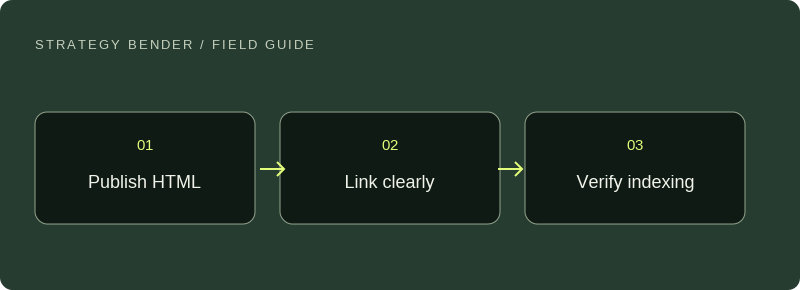
- Request the article URL directly. Confirm that its heading and main text appear before scripts run.
- Check the title, description, canonical URL, response status, and internal links together.
- Compare structured data with the visible author, dates, and content. Remove any unsupported claims.
- Confirm the page appears in the sitemap and is reachable from the article index.
- After release, use search-engine inspection tools to investigate indexing; a successful HTTP request alone does not prove inclusion.
What should a team measure?
Keep a small record of published URLs, inspection results, and relevant enquiries. Review it alongside search traffic. This connects editorial work to a business question: can someone find a useful answer and understand the next step? A crawler-access file or an attractive score cannot answer that question by itself.
Source review: 15 November 2026. This is an editorial guide based on the linked documentation, not a report of client results.