
What do Core Web Vitals measure?
Core Web Vitals cover loading, responsiveness, and visual stability. Google's published good thresholds are LCP at or below 2.5 seconds, INP at or below 200 milliseconds, and CLS at or below 0.1. Assessment uses the 75th percentile of page loads, with mobile and desktop considered separately. See the definitions and measurement guidance.
A lab test is useful for reproducing a problem under controlled conditions. Field measurements describe what real visitors experienced. One successful local run does not establish that a site passes in the field.
Choose a representative journey
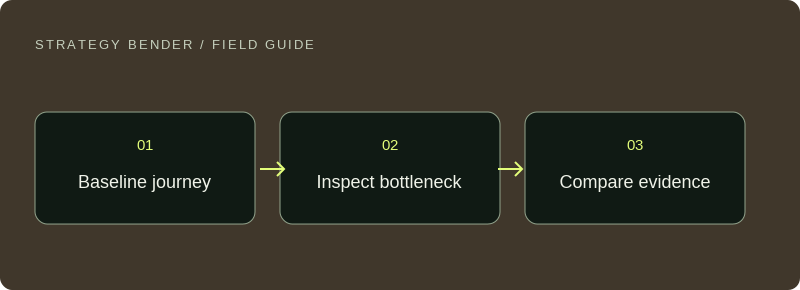
Our recommendation is to baseline three pages: the entry page, a content-heavy page, and the page where someone takes action. Record the device settings, connection profile, build, route, and measurement time. Keep those conditions consistent when comparing a change.
For a professional services site, test the contact form and navigation as well as the opening visual. The fastest hero image is little help if the next interaction leaves the visitor waiting without feedback.
Investigate one symptom at a time
- Late main content: inspect the critical image, font loading, server response, and request sequence. Identify the resource on the affected route before changing the whole site.
- Slow interactions: reproduce the exact click or input. Look for synchronous work and unnecessary rendering around that event.
- Moving content: reserve space for media and examine components inserted after loading. Check the page while requests finish, not only after it settles.
These are investigation paths, not a guarantee that every site has the same cause.
Keep the comparison honest
Store before-and-after evidence from the same conditions, along with a short explanation of what changed. Release the smallest useful fix and watch for regressions in real traffic when data is available. If field data is missing, label the result as a lab observation. That distinction is more useful to the next engineer than a score without context.
Source review: 15 November 2026. This is an editorial guide based on the linked documentation, not a report of client results.