
Why can a deployment look different to two visitors?
A visitor may reuse a stored response while another requests a new one. HTTP caching rules determine when stored content can be reused or must be validated. MDN explains that no-cache requires validation before reuse; no-store instructs caches not to store the response. Those directives solve different problems. Read the caching guide.
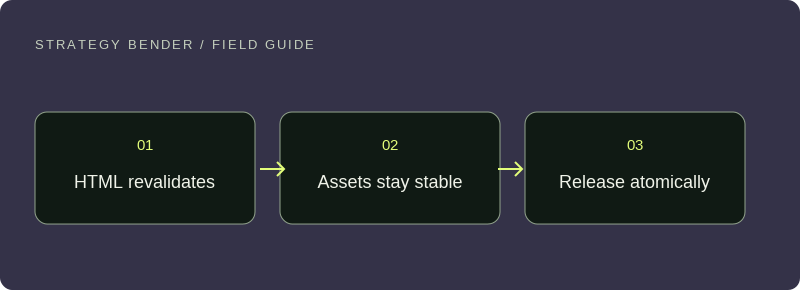
Content-hashed asset URLs let a release change a file's identity when its contents change. A long cache lifetime with immutable is useful for those stable URLs. HTML whose URL stays the same needs a policy that allows visitors to discover updates.
Make a cache map
Our recommendation is to inventory the response classes before editing server configuration:
- Entry HTML and route HTML: decide how browsers discover a new release.
- Hashed JavaScript, styles, and images: ensure a given URL always represents the same bytes.
- Personal data and authenticated responses: review storage and shared-cache behaviour separately.
- Public API responses: decide how much staleness the product can tolerate and show freshness where it matters.
Do not copy a single cache header across the entire server. A media asset and a private account response have different requirements.
Design the release around open sessions
Consider a visitor who opened an article before deployment and clicks another route afterwards. Our deployment recommendation is to retain the older assets for a defined overlap period and switch the active release atomically. Record which release is current and which one is the rollback target.
This is an operational choice to test against the application's routing and asset-loading behaviour, rather than a universal retention duration.
Verify responses, not just configuration
Request the actual route and an actual hashed asset after release. Inspect their headers and bytes. Then repeat the journey from a previously opened browser session. Finally, exercise rollback in a safe environment. This checks the user-visible contract that a configuration review alone cannot establish.
Source review: 15 November 2026. This is an editorial guide based on the linked documentation, not a report of client results.